
If your tour business is growing, your booking system needs to keep up with inventory, OTA sync, payments, and reporting at the same time. This roundup covers Rezdy, Bókun, TrekkSoft, Checkfront, TourCMS, bookingkit, and Lunacal with a simple focus: who each tool fits, where it sells best, and what to watch in pricing.
Here’s the short version:
- Rezdy: strong for OTA and reseller sales
- Bókun: good if OTA reach is your main focus
- TrekkSoft: built for multi-channel growth and live sync
- Checkfront: better for mixed bookings, rentals, and direct sales
- TourCMS: made for channel-heavy setups
- bookingkit: geared toward OTAs, Google, and local partners
- Lunacal: best for direct bookings and appointment-style tours
A few points stand out fast:
- 63% of online bookings in 2025 come from mobile, so your checkout flow needs to work well on phones
- OTA-heavy setups can bring volume, but fees can stack up fast
- Direct-booking tools can cut channel costs, but they usually do less on OTA sync
- The right pick depends on how you sell: OTA-led, direct-led, or mixed
My takeaway: if you sell mainly through marketplaces like Viator and GetYourGuide, look first at Rezdy, Bókun, and TrekkSoft. If you want one place for tours, rentals, and custom booking rules, Checkfront stands out. If your growth comes from direct bookings, Lunacal is the clearest fit.
Choosing the right booking system for tour operators
sbb-itb-3dd36ef
Quick Comparison
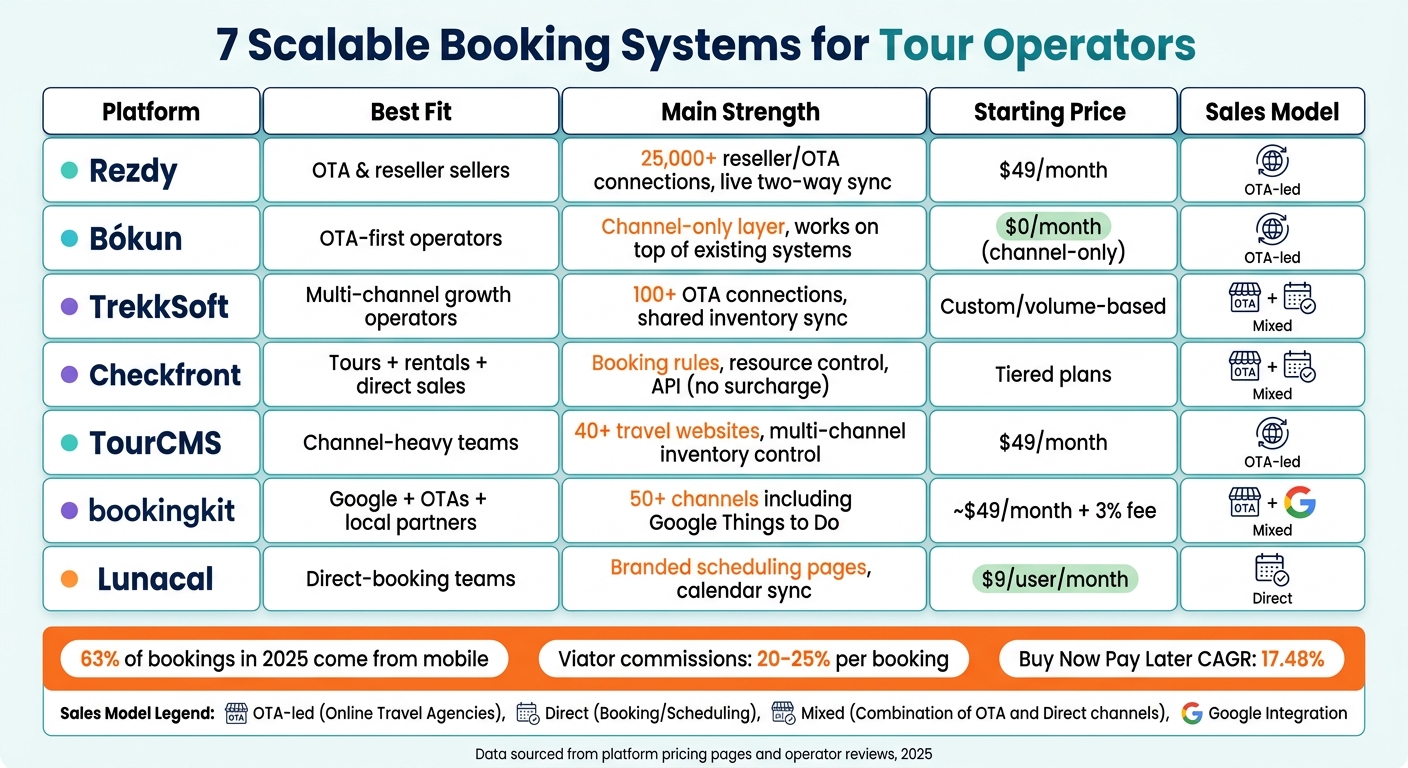
7 Best Booking Systems for Tour Operators: Side-by-Side Comparison
| System | Best fit | Main strength | Pricing snapshot |
|---|---|---|---|
| Rezdy | OTA and reseller sellers | Large partner network and live sync | From $49/month |
| Bókun | OTA-first operators | Channel access, can sit on top of another system | From $0/month for channel-only |
| TrekkSoft | Multi-channel growth | 100+ OTA links and shared inventory | Custom / volume-based |
| Checkfront | Tours + rentals + direct sales | Booking rules, resource control, API options | Tiered plans |
| TourCMS | Channel-heavy teams | Multi-channel inventory control | From $49/month |
| bookingkit | Google + OTAs + local partners | Channel sync and Google Things to Do | From about $49/month + fees |
| Lunacal | Direct-booking teams | Branded scheduling pages | From $9/user/month |
If I were shortlisting tools, I’d compare them on just five things first: channel reach, live inventory sync, direct booking flow, integrations, and total cost at higher volume.
What Growing Tour Operators Need From a Scalable Booking System
For U.S. tour operators, scalability comes down to one thing: keeping inventory, channels, payments, and reporting aligned as booking volume climbs. If even one of those slips, things get messy fast. The platform needs to handle all four at the same time.
Real-time inventory management is where it starts. If a booking comes in from Viator, your website, and a hotel concierge at nearly the same moment, availability should update everywhere right away. If it doesn’t, double bookings show up. And cleaning that up during a busy July weekend can eat up time, money, and customer trust. A solid system runs on one live inventory pool across all channels.
OTA and reseller sync matters just as much. The built-in channel manager should update pricing and availability in real time. At the same time, the booking engine needs to stay fast and mobile-friendly for direct sales. That’s a main point in each platform review below.
U.S. travelers expect a smooth checkout. That means credit cards, debit cards, and digital wallets, clear USD pricing, correct taxes, and instant confirmations. Buy Now Pay Later options are also growing fast, with a projected 17.48% CAGR. Your platform should manage all of this without extra manual follow-up.
Reporting and integration flexibility often make the difference between a platform that helps you grow and one that starts to hold you back. You need clear data on which channels and tours bring in the most revenue, how full your departures are, and where bookings drop off. As your tech stack gets bigger, the booking system should connect with accounting, CRM, and marketing tools through APIs and webhooks.
These criteria guide the seven platform reviews below.
1. Rezdy
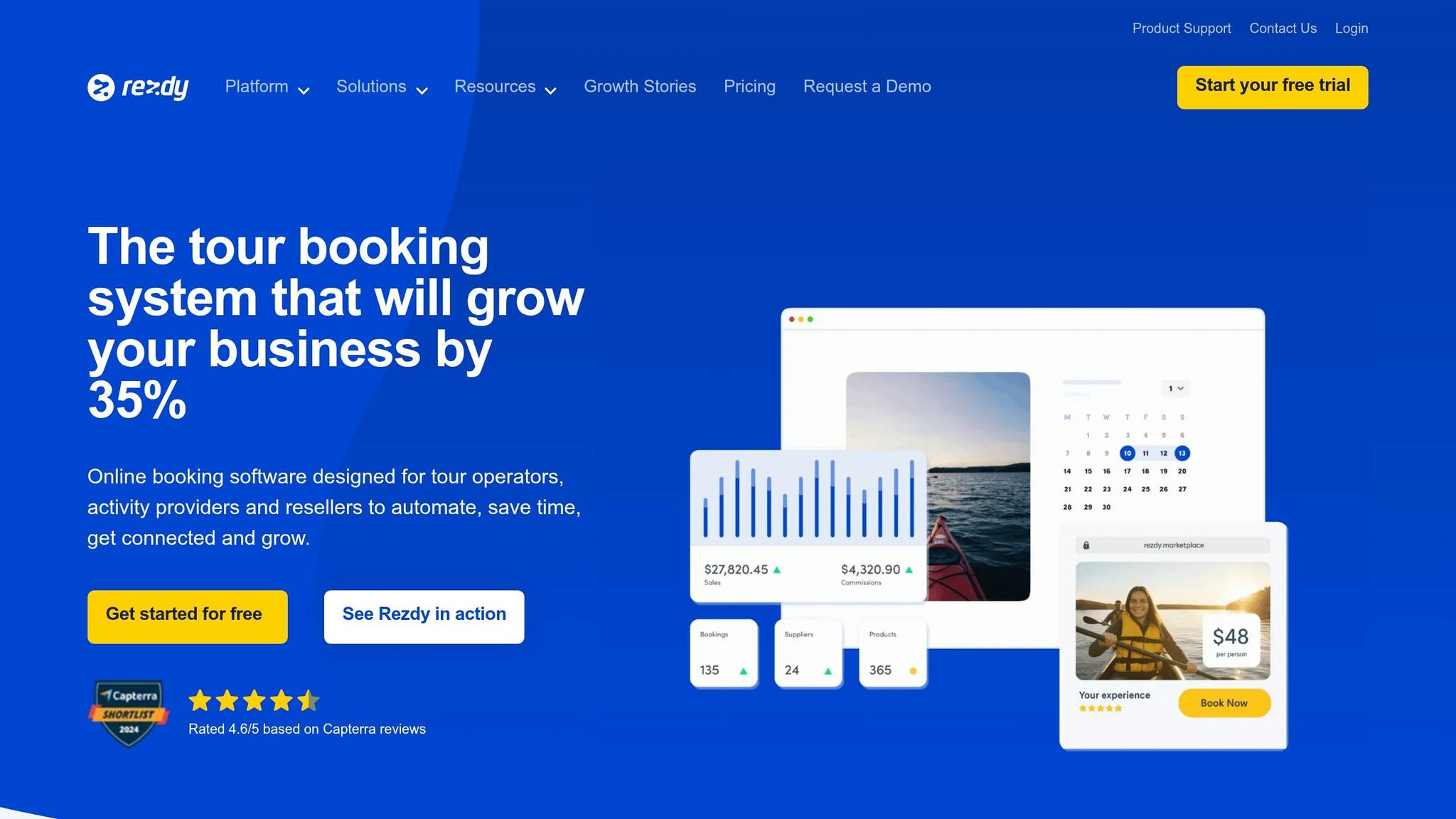
Rezdy is a cloud booking and distribution platform built for tours, activities, and attractions. It works well for operators that need live inventory, OTA sync, and partner distribution in one place.
One of Rezdy’s big strengths is its Channel Manager. It connects to 25,000+ resellers and OTAs, including Viator, GetYourGuide, Expedia, Klook, and TripAdvisor, with real-time two-way sync.
Rezdy also has a Marketplace feature that helps operators handle hotel, visitor-center, and partner commissions from a single dashboard.
If your setup needs custom tools or deeper back-office connections, Rezdy includes a REST API, webhooks, and native integrations for Xero and QuickBooks. That gives teams more room to connect booking data with accounting systems or custom front ends without stitching everything together by hand.
Pricing is split into three tiers:
| Plan | Monthly Fee | Booking Fee (Direct/Web) |
|---|---|---|
| Foundation | $49/month | 2% per booking |
| Accelerate | $99/month | 0.8% per booking |
| Expansion | $249/month | 0% per booking |
Marketplace and OTA bookings come with separate commissions based on each channel agreement.
Best for operators that rely on OTAs, resellers, and partner distribution.
2. Bókun

For operators that grow through OTA sales, Bókun is built with channels in mind first. Tripadvisor owns it, and it connects with major OTAs and reseller networks like Viator, GetYourGuide, Expedia, Klook, and Trip.com.
Bókun can work in two ways: as your main reservation system or as a channel-management layer on top of the system you already use. That matters if you want OTA reach without ripping out your current setup.
When a booking comes in, inventory updates across connected channels right away. That helps cut down the risk of double bookings. Bókun also supports dynamic pricing through its API, so operators can manage day-to-day rates and set up multiple pricing schedules.
Pricing is pretty straightforward at first glance. Bókun has a free Channel Manager plan at $0/month that includes OTA and marketplace connectivity, but it doesn't include a direct booking widget. Paid plans add the booking widget, automated emails, vouchers, and resource management.
There is one catch: operators also need to factor in channel commissions. Bókun charges channel fees on some bookings, and Viator adds its own commission too. In many cases, Viator's cut lands around 20% to 25% of the booking value, on top of Bókun's fees.
Best for operators who want to scale OTA distribution without overhauling their existing reservation system.
If you need tighter control over direct bookings, the next platform goes in a different direction.
3. TrekkSoft
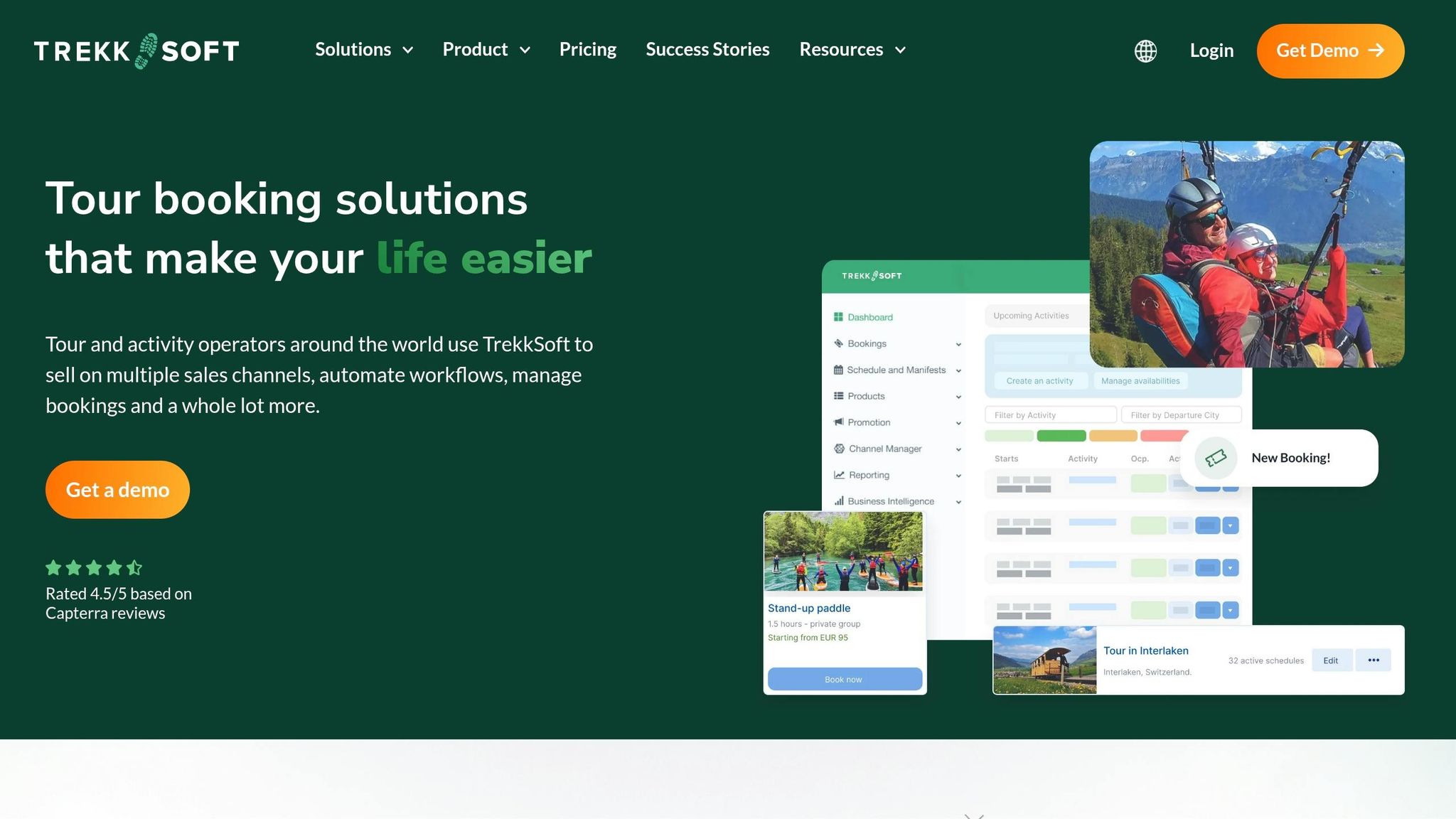
TrekkSoft is a better fit for operators that need broad distribution and live inventory control. At the center of the platform is a channel manager that connects to more than 100 OTAs and marketplaces, including Viator, GetYourGuide, Expedia, Klook, and Civitatis.
That matters because TrekkSoft keeps inventory, schedules, prices, and availability synced in real time across direct, reseller, agent, and OTA channels. So if you change pricing in one place, that update can roll out everywhere at once. A holiday weekend price bump or a last-minute discount doesn't have to be updated channel by channel.
TrekkSoft also goes beyond OTA distribution. Its Partner Network lets operators resell each other's tours with automated commissions and shared inventory. On top of that, hotel concierges, visitor centers, and local agents can use TrekkSoft's in-person booking tools to check live availability, issue vouchers, and support in-destination sales.
For teams with more technical needs, TrekkSoft includes Open API access and TrekkConnect, a unified channel API that shares content and live availability with many resellers through one integration. It also connects with Google Analytics, Xero, Stripe, PayPal, and Zapier. One thing to watch: API access is often limited to higher-tier plans, so teams that rely on heavy integrations should plan for that in the budget.
Pricing is subscription-based, with per-booking fees that change by channel type. In practice, total cost depends on booking volume and channel mix.
The upside shows up in operator results. Viking Biking saw online bookings grow by 25% after adopting TrekkSoft, while Sea Saffron reported a 50% year-over-year increase in direct bookings and a 75% drop in marketing expenses.
Best for operators that want broad OTA distribution, live inventory sync, and room to build a connected tech stack as they grow.
4. Checkfront
Checkfront puts less weight on broad distribution and more on day-to-day booking control. If you need one place to manage reservations, capacity, and pricing, that’s where it stands out. It works well for operators selling direct, through resellers, and on OTAs from the same system. It connects with Viator, Expedia, GetYourGuide, Tripadvisor, Google Things to Do, and MyAllocator, so availability stays synced across channels without manual updates.
On the booking side, Checkfront supports seasonal pricing, custom rules, resource assignment, capacity limits, cut-off times, blackout dates, and both multi-day and timeslot bookings. That setup makes sense for operators running tours and rentals together and wanting one dashboard instead of patching jobs across different tools.
Its integration setup is also broad. Checkfront offers a REST API, webhooks, and 50+ native connections. For payments, it works with Stripe, Square, and PayPal. For accounting, CRM, and marketing, it connects with QuickBooks Online, Xero, HubSpot, Salesforce, and Mailchimp. If you’re on a higher-tier plan, Zapier opens the door to 3,000+ more apps.
Pricing comes in several tiers, including Soho, Pro, Plus, Enterprise, Growth, and Managed. As you move up, you get more integrations, support for multiple locations, and more advanced automation. Some plans also come with annual booking caps and limits on staff seats, so it’s smart to match your must-have features with the plan details before you pick one.
Best for small-to-mid-sized operators moving from direct bookings into multi-channel sales and needing one inventory hub for tours, rentals, and other mixed products.
If you need tighter channel-management controls, the next option is worth a look.
5. TourCMS
For operators whose growth depends on where they sell, TourCMS puts distribution front and center. It’s built for teams that manage inventory across a lot of sales channels, and it has focused on tours and activities distribution since 2003.
On that front, TourCMS connects with GetYourGuide, Viator, Expedia, and Hotelbeds, along with many others. In total, operators can reach more than 40 travel websites from one system. It also supports distribution for Gray Line licensees and destination groups such as Turisme de Barcelona.
That setup matters when booking volume starts to climb. If a booking comes in through any connected channel, availability updates across the board on its own. That helps cut down on overbooking and keeps direct sales plus partner sales tied to the same inventory source.
The API is RESTful and XML-based. It covers tours, dates, pricing, bookings, vouchers, and payments. Operators that want more control can run their own booking engine through the API. For partners that don’t have full API access, TourCMS also offers webhooks and JavaScript widgets.
Pricing is based on channel count and monthly booking volume. Plans start at $49/month for up to 2 channels and 30 bookings. From there, pricing moves to about $159, $329, and $569/month for 5, 20, and 25 channels. There’s also a 1.9% distribution fee on bookings that come through connected partners.
Best for operators with established multi-channel distribution needs, especially those working with agents, DMOs, or several OTA partners who want one inventory source instead of managing each channel on its own.
6. bookingkit
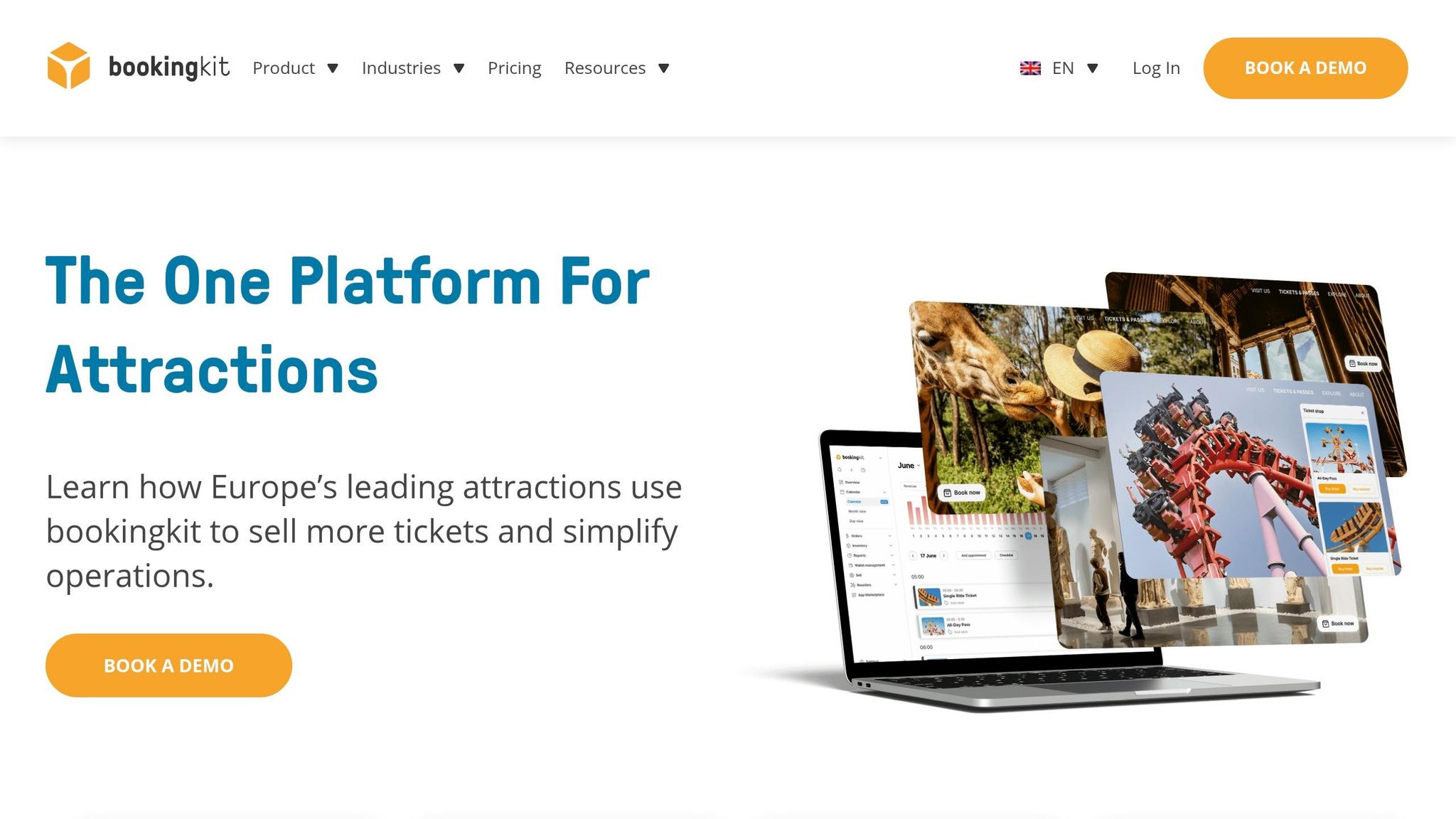
For operators that want more sales channels and better Google presence, bookingkit gives them a lot more control over distribution. It supports 50+ channels, including major OTAs and Google Things to Do, which helps operators show their inventory in Google Search and Maps while still keeping customer data on their side.
The setup is pretty simple in practice: operators add an experience once, and bookingkit syncs dates, times, capacity, and pricing across every connected channel. That saves a lot of manual work. It also helps cut down on the mess that comes with updating each partner one by one. On top of that, operators can set quotas for each channel, which makes it easier to give more inventory to higher-value partners.
On the B2B side, bookingkit Reach lets hotels, visitor centers, DMOs, and other local partners sell through trackable booking links or white-label pages, all tied to one synced calendar. For bigger operators, that same distribution approach also carries over into on-site operations.
bookingkit also connects with Axess, linking online sales with on-site entry and parking management while showing live availability updates.
Base pricing starts at about $49/month, plus around 3.0% per booking and an extra fee. If you're a U.S. operator, it's smart to confirm USD billing, tax setup, and payment processing before you buy.
Best for operators whose main growth plan is multichannel distribution - especially those that want to sell across major OTAs, Google, and a local reseller network from one system without handling each channel on its own.
7. Lunacal
Lunacal is a good fit when your growth comes more from direct bookings than from channel distribution. Instead of putting the focus on OTAs, it centers on branded scheduling pages that work like landing pages for booking. That means operators can show off services with custom copy, images, and video, which can help more visitors book without extra steps.
This setup is built for teams that want to grow direct sales, not manage OTA distribution. Put simply: it helps you scale the direct-booking side without piling on channel-management work.
Lunacal also syncs in real time with Google Calendar, Outlook, and Apple Calendar. So if a time slot is already taken, it gets blocked automatically. It also supports round-robin and collective scheduling, which helps when bookings need to be routed across team members. On top of that, operators can set buffers and minimum notice periods for each event type.
For direct-booking workflows, Lunacal connects with Zapier, webhooks, HubSpot, and Pipedrive. That makes it easy to push booking data into a CRM or send it into an automated follow-up flow.
| Plan | Price | Includes |
|---|---|---|
| Standard | $9 per user/month | Core scheduling and payment collection |
| Teams | $15 per user/month | Round-robin and collective scheduling |
| Enterprise | $25 per user/month | Custom integrations and onboarding support |
Annual billing can cut costs by up to 20%. For example, a three-guide team on the Teams plan would pay about $45/month, or about $432/year.
Best for operators that rely on direct bookings and need a branded, low-friction scheduling page for small-group or appointment-style tours.
A Useful Resource for Comparing Booking Software
Once you’ve looked at the seven systems above, the next move is seeing how each one fits into your broader tech stack. A booking platform almost never stands alone. As operators grow, they often need to look at channel managers, digital waiver tools, CRM platforms, payment processors, and marketing automation at the same time. If you compare each tool on its own, the process gets slow fast, and it’s easy to miss integration gaps.
Directoury is a free resource built for tour operators, activity providers, and experience businesses. It connects operators with 200+ verified software vendors across booking systems and related tools like waivers, payments, CRM, marketing automation, and channel management. You can compare vendors side by side and spot which tools make sense for your stack.
If scalability is a big part of your decision, Directoury also uses AI-powered recommendations to match vendors to your tour type, business size, and integration needs. On top of that, it offers an 8-minute assessment, buyer’s guides, and side-by-side comparisons of up to five products. That makes it a handy way to trim down your shortlist before getting into the comparison below.
Side-by-Side Comparison
The table below lines up the seven systems across five decision points. Use it to trim your shortlist based on distribution model, sync depth, and integration needs. Pricing appears only where public data is available.
| System | Distribution | Inventory & Availability Sync | API & Integrations | Pricing at Scale | Best Use Case |
|---|---|---|---|---|---|
| Rezdy | Broad OTA and reseller reach. | Two-way, real-time sync of rates, availability, and bookings. | RezdyConnect API for custom booking solutions and third-party platforms. | Distribution-focused model; public pricing not clearly surfaced. | Mid- to large-size operators prioritizing OTA and reseller reach. |
| Bókun | OTA-first distribution via a single marketplace connection. | Real-time sync of inventory, availability, pricing, and bookings across channels. | Channel Manager API and developer docs; Zapier on higher tiers. | Hybrid: monthly plan + tiered booking fees that decrease at higher volumes. | Multi-channel operators wanting real-time distribution control. |
| TrekkSoft | 100+ OTA and marketplace connections. | One-dashboard sync of bookings, inventory, schedules, and prices. | API plus channel-manager workflows. | Subscription tiers; exact public pricing not clearly surfaced. | Growing operators focused on OTA volume and automation. |
| Checkfront | Select OTA and add-on integrations. | API returns rated availability and calendar endpoints with pricing data. | Strong developer API for custom front ends; no extra fee on API-generated bookings. | Monthly subscription + 3% online booking fee; API bookings not surcharged. | Operators building custom booking experiences or needing flexible inventory logic. |
| TourCMS | Webhook-driven channel workflows. | Webhooks notify live availability updates and booking/cancellation events. | API supports dates, prices, and webhook-based sync with external systems. | Not publicly surfaced. | Operators with complex internal reservation systems or B2B workflows. |
| bookingkit | API-first integrations. | Availability sync details not clearly documented in public sources. | Third-party API integration for website and management software connectivity. | Not publicly surfaced. | Businesses needing custom integration over out-of-the-box distribution. |
| Lunacal | Direct-booking and scheduling focused. | Two-way sync with Google, Outlook, and Apple calendars. | Zapier, webhooks, CRM, payments, and conferencing tools. | Free plan available; paid tiers around $9–$25/user/month. | Small teams, service-style bookings, or operators needing simple scheduling. |
A simple pattern shows up here. If your growth depends on OTA volume, Rezdy, Bókun, and TrekkSoft are the ones built around real-time multi-channel distribution. They make the most sense when your business lives or dies by marketplace reach.
If you care more about cost control as volume grows, Checkfront has a clear edge because its API access doesn’t add per-booking surcharges. That can matter a lot once booking volume starts to pile up.
Conclusion
After looking at channels, integrations, and pricing, the choice comes down to fit. The best system is the one that lines up with your booking channels, workflow, integrations, and long-term cost.
Pick a platform that matches how you sell. If you lean hard on OTAs, you need strong channel sync. If you sell direct, you need a fast checkout and solid payment tools. If your setup is more involved, you’ll want deeper inventory control and automation.
Once you know which workflow fits, map out your total cost at future booking volume before you commit. That part matters a lot, because pricing often shifts as you grow.
Start by mapping your booking workflow, spotting the bottlenecks, and matching them to the system that fixes them. Then use the same criteria from the comparison table - channel fit, sync depth, integrations, and total cost - to make the final call. The best booking systems keep inventory, distribution, and cost in step as volume goes up.
If you want help narrowing down your options, Directoury offers free platform comparisons and guidance for experience operators.
FAQs
How do I choose between OTA-first and direct-booking systems?
Balance your use of third-party channels with your goal of owning the guest experience. If cutting commissions is the main goal, put direct bookings front and center - for example, aim to grow them by 20% over 12 months.
Direct-booking systems let you keep more of your revenue, automate day-to-day work, and gather data that can help you improve conversion and guest satisfaction. OTAs can bring more visibility, but they often come with steep commissions.
It also pays to look for strong API integrations and solid analytics. That makes it easier to compare channel performance and avoid overbookings.
What costs rise most as booking volume grows?
As booking volume grows, the main costs that go up are transaction fees, subscription upgrades, and integration-related expenses.
More volume often means higher charges through tiered pricing or per-booking fees. It can also bring extra costs for advanced features, add-ons, premium support, performance monitoring, or fixing technical inefficiencies.
Which booking system is best for tours, rentals, and custom rules?
The best booking system comes down to two things: how complex your setup is and how many bookings you handle.
If you run tours, rentals, or anything with custom rules, look for a platform with real-time availability, website integration, and enough flexibility to handle the way your bookings actually work. That matters more than flashy features.
If your needs are very specific, a custom-built system can give you more control. But if you want to get up and running faster and avoid a big upfront bill, a flexible off-the-shelf platform is usually the better fit.