A CRM (Customer Relationship Management) system helps tour operators manage customer interactions, automate repetitive tasks, and keep all client details in one place. If you're juggling emails, spreadsheets, and sticky notes to track bookings, follow-ups, and customer preferences, a CRM can simplify your workflow and reduce errors.
Key benefits include:
- Centralized customer data: Easily access booking history, preferences, and communication records.
- Automation: Handle tasks like sending booking confirmations, payment reminders, and follow-up emails automatically.
- Lead tracking: Know where each inquiry stands and improve response times.
- Better marketing: Send personalized offers based on customer preferences, boosting loyalty and repeat bookings.
With prices starting as low as $14/month, CRMs are now accessible for businesses of all sizes. They help save time, reduce manual work, and improve customer satisfaction, which can directly increase revenue. If you're losing leads or spending too much time on admin tasks, investing in a CRM could be the solution.
CRM for Tour Operators | How to Determine the Best CRM For Your Tour Operations Company
What Is a CRM?
A Customer Relationship Management (CRM) system is essentially a centralized software tool that helps businesses manage all their customer interactions and relationships in one place. Instead of juggling separate records or platforms, a CRM acts as a single, reliable hub for everything related to your customers - from their initial inquiry to the feedback they provide after their experience.
Picture it as a digital archive that holds all your customer information. It stores details like contact information, booking history, and notes from every interaction. Whether a customer reaches out via email, WhatsApp, or an online form, the CRM organizes all these touchpoints into a seamless timeline.
One of the most powerful aspects of a CRM is automation. It handles repetitive tasks like sending booking confirmations, payment reminders, and follow-up messages. This not only saves valuable time but also reduces costly errors from manual data entry - mistakes that can cost businesses millions each year.
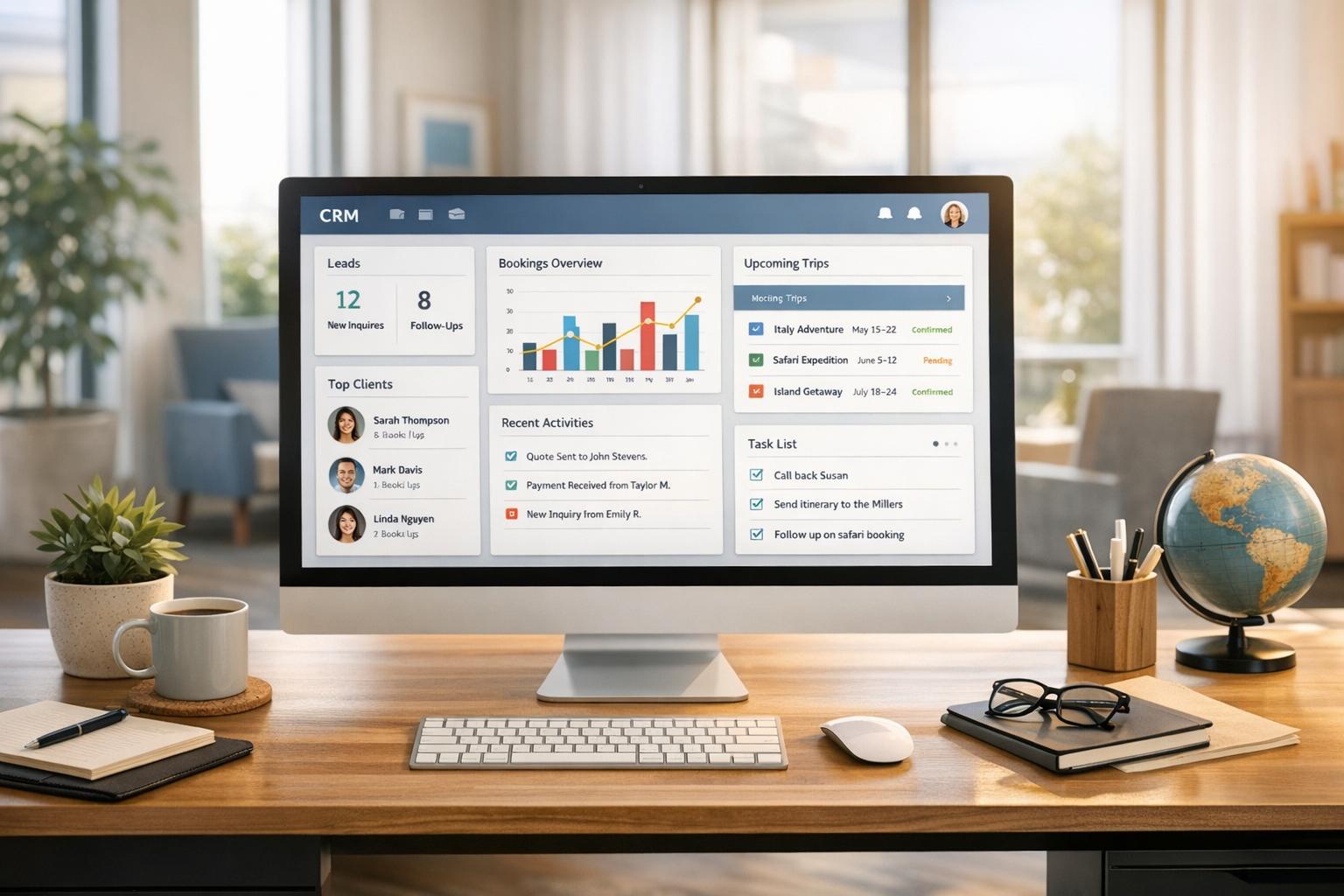
CRMs also offer visual tools, like pipelines, to track the status of every inquiry. At a glance, you can see which leads need quotes, which are awaiting payments, and which are fully confirmed. During busy seasons, this kind of organization ensures no opportunity slips through the cracks. These features are at the heart of what makes a CRM so effective.
"Pipedrive mainly has the huge advantage of working in a very centralized way – we can integrate almost the entire sales and marketing process into one system."
– Olmo van Beurden, Co-founder, Surfawhile
Main Features of a CRM
Contact management is the backbone of any CRM. It allows you to capture not just basic details like names and email addresses, but also specific travel-related preferences - such as accessibility needs, past destinations, budget ranges, and personal likes.
Lead tracking ensures you know exactly where each inquiry stands in your sales process. For example, instead of wondering whether you followed up with a family interested in a safari, the CRM keeps a detailed record of every interaction and even reminds you when to reach out. Surfawhile, a surf holiday company, implemented Pipedrive in December 2025 and saw impressive results: they nearly tripled their leads and reduced sales time by 40%, thanks to better lead visibility and automated follow-ups.
Automated messaging simplifies routine communications. The system can instantly send booking confirmations, pre-trip reminders, and post-trip review requests - all without manual effort. Some CRMs even tackle abandoned bookings by automatically reaching out to customers who didn’t complete their reservations.
Reporting tools replace outdated spreadsheets with live dashboards. These tools let you monitor sales trends, evaluate the success of your marketing campaigns, and identify peak booking periods. As Jessica Gregory, VP of Marketing at Palisis, puts it:
"It's about being able to use the analytics to provide business data that you would either struggle to mine out of a spreadsheet or would take a lot of time and effort to set up those workflows."
– Jessica Gregory, VP of Marketing, Palisis
These features can be game-changing, especially for smaller businesses.
Why Small Businesses Need CRM
CRMs are no longer just for big corporations. With entry-level pricing starting at just $14 per month, they’re now accessible to businesses of all sizes.
For small businesses, where resources are often stretched thin, the efficiency gains from a CRM are invaluable. When you’re managing bookings, coordinating with suppliers, handling inquiries, and running social media, automation becomes a necessity. A CRM can integrate with your existing reservation and accounting tools, cutting down on double data entry and freeing up your time to focus on what matters most - delivering unforgettable experiences.
Customer retention is another area where CRMs shine. By keeping track of past preferences and travel history, you can send personalized offers that feel thoughtful rather than generic. Businesses using CRMs report a 26% boost in customer retention rates and a 47% increase in customer satisfaction. Since repeat customers typically spend more than first-time travelers, these improvements can directly impact your bottom line.
Problems Tour Operators Face Without a CRM
Operating a tour business without a centralized CRM turns everyday tasks into significant hurdles. These obstacles drain time, money, and customer trust, making it harder to stay competitive.
Customer Information Scattered Everywhere
When customer details are spread across emails, spreadsheets, or even sticky notes, maintaining accuracy becomes a nightmare. A simple typo or manual entry error can cost businesses millions annually, and even a small mistake - like missing a dietary restriction - can lead to service failures and unhappy customers. Without a single, reliable system to manage this information, teams risk overlooking critical details, which not only damages customer satisfaction but also impacts repeat bookings.
Missed Opportunities Due to Slow Follow-Up
In the travel industry, timing is everything. Responding to inquiries within an hour makes conversations seven times more likely to convert, while waiting 24 hours slashes lead qualification rates by 60%. Relying on manual tracking during busy seasons often results in delayed responses, expired quotes, and lost bookings.
On top of that, 68% of customers leave businesses because they feel neglected. Without quick follow-up, potential clients may assume their business isn't a priority, eroding trust and reducing the likelihood of securing bookings.
Excessive Time Spent on Administrative Tasks
Manual processes eat up hours that could be better spent on building relationships and closing sales. Tasks like managing inquiries, creating quotes, sending emails, setting reminders, and processing invoices quickly pile up. It's a time sink that diverts attention from what truly matters: engaging with clients.
In fact, 77% of sales professionals say that using a CRM significantly cuts down on admin work, giving them more time to focus on customers and revenue-generating activities. In a competitive market, every minute spent on paperwork is a missed opportunity to grow your business.
These pain points underline the importance of a centralized CRM - not just for organizing data, but for enabling faster follow-ups and minimizing time wasted on manual tasks.
How a CRM Fixes These Problems
A CRM tackles the challenges of disorganized data and manual processes by centralizing information and automating tasks. Instead of juggling multiple tools and risking mistakes like missed bookings, it brings all customer interactions into one easily accessible system for your entire team.
All Customer Data in One Place
Forget the chaos of scattered spreadsheets, sticky notes, or endless email threads. A CRM consolidates everything - customer inquiries, bookings, payments, and feedback - into one secure database. This means no more digging through emails to find details like dietary preferences or trying to remember which spreadsheet has a client’s passport info.
It doesn’t stop there. A CRM organizes interactions from various channels - emails, WhatsApp, live chats, and website forms - into a single, chronological timeline. When a customer reaches out, your team has instant access to their full conversation history and key details. This real-time visibility helps avoid double bookings and ensures everyone, from tour guides to sales reps, stays aligned.
Take Surfawhile, a surf holiday company, as an example. In December 2025, they used Pipedrive to centralize customer communications and sales processes. Co-founder Olmo van Beurden shared how the company nearly tripled its leads while cutting sales time by 40%. He explained:
"Pipedrive mainly has the huge advantage of working in a very centralized way – we can integrate almost the entire sales and marketing process into one system."
With all data in one place, automation becomes the next step to simplify operations.
Automated Tasks Save Time
A CRM eliminates tedious, repetitive tasks by automating them. It can send instant responses to new inquiries, assign leads to team members, and set reminders for follow-ups - all without manual effort. Booking confirmations, payment reminders, and branded invoices? Those are handled automatically too.
Automation doesn’t stop at communication. CRMs can manage trip logistics like waiver requests, supplier checklists, and post-trip reviews. Even potential customers who abandon the booking process aren’t forgotten - some systems send recovery emails automatically. These efficiencies can reduce labor costs by up to 40% and boost productivity by 34%.
Better Marketing and Customer Communication
Centralized data and automation also supercharge your marketing. A CRM uses customer insights to segment your audience based on travel history, preferences, and booking behavior. This means you can send targeted campaigns rather than generic messages. For instance, you could promote seasonal tours specifically to adventure travelers. By tailoring campaigns to individual preferences, you ensure every interaction feels personal. This approach pays off, as repeat travelers often spend more than first-time customers.
Automation enhances the customer journey from start to finish. Pre-trip reminders, itinerary updates, and post-trip follow-ups are all sent at just the right time. You can even create workflows to share personal trip photos or offer referral incentives after a trip ends. Plus, CRM analytics reveal booking patterns and seasonal trends, helping you time your marketing campaigns perfectly.
Jessica Gregory, VP of Marketing at Palisis, highlighted this advantage:
"It's about being able to use the analytics to provide business data that you would either struggle to mine out of a spreadsheet or would take a lot of time and effort to set up those workflows."
sbb-itb-3dd36ef
Main Benefits of Using a CRM
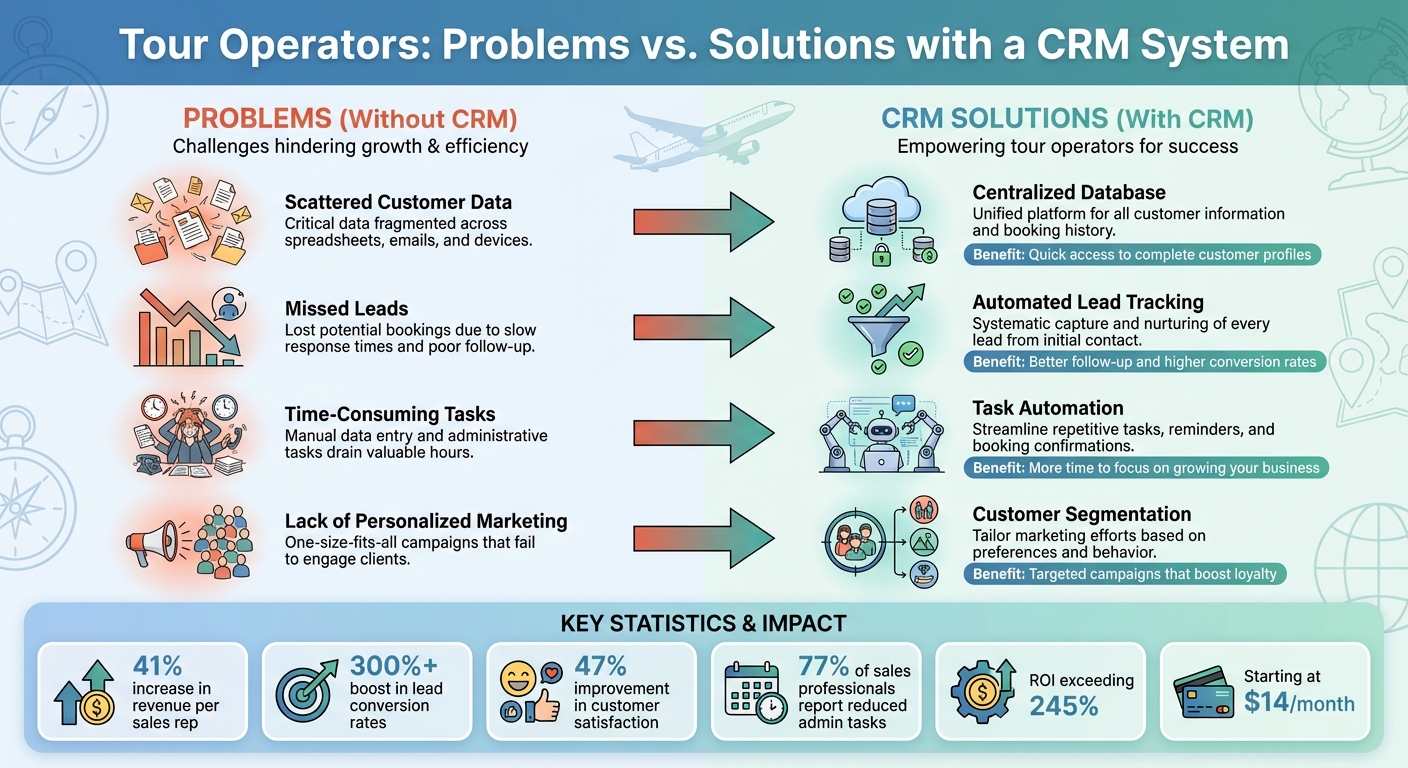
Tour Operator CRM: Problems vs Solutions Comparison
A CRM can transform how you manage your business, delivering measurable gains in revenue, efficiency, and customer satisfaction - all of which directly impact your bottom line.
Problems vs. Solutions Comparison
Here's a quick look at how a CRM tackles common challenges faced by tour operators:
| Challenge | CRM Feature | Benefit |
|---|---|---|
| Scattered customer data | Centralized database | Quick access to complete customer profiles |
| Missed leads | Automated lead tracking | Better follow-up and higher conversion rates |
| Time-consuming tasks | Task automation | More time to focus on growing your business |
| Lack of personalized marketing | Customer segmentation | Targeted campaigns that boost loyalty |
These features don’t just solve operational headaches - they also pave the way for meaningful business growth.
How CRM Affects Business Growth
Beyond streamlining operations, a CRM can be a real driver of growth. By eliminating issues like disorganized data and delayed follow-ups, it creates a solid foundation for increasing revenue and improving customer experiences.
For instance, CRM systems have been shown to boost revenue per sales representative by 41%. This happens because reps spend less time buried in paperwork and more time closing deals. Automated follow-ups are another game-changer, increasing lead conversion rates by over 300% while cutting overall costs by 23%. Plus, the sales cycle itself shrinks by 8% to 14%, speeding up the process from inquiry to booking.
Customer satisfaction also sees a big lift - by as much as 47%. Many customers leave when they feel overlooked, but a CRM helps prevent this by enabling personalized, timely communication. Whether it’s remembering a client’s dietary preferences or sending a tailored offer for their favorite type of adventure, these thoughtful touches make customers feel valued.
The financial return speaks for itself. A properly implemented CRM delivers an ROI exceeding 245%. And it’s not just about profits - your team benefits too. About 77% of sales professionals report that CRMs reduce administrative tasks, giving them more time to focus on what truly matters: building strong relationships and creating unforgettable travel experiences.
Finding CRM Solutions with Directoury
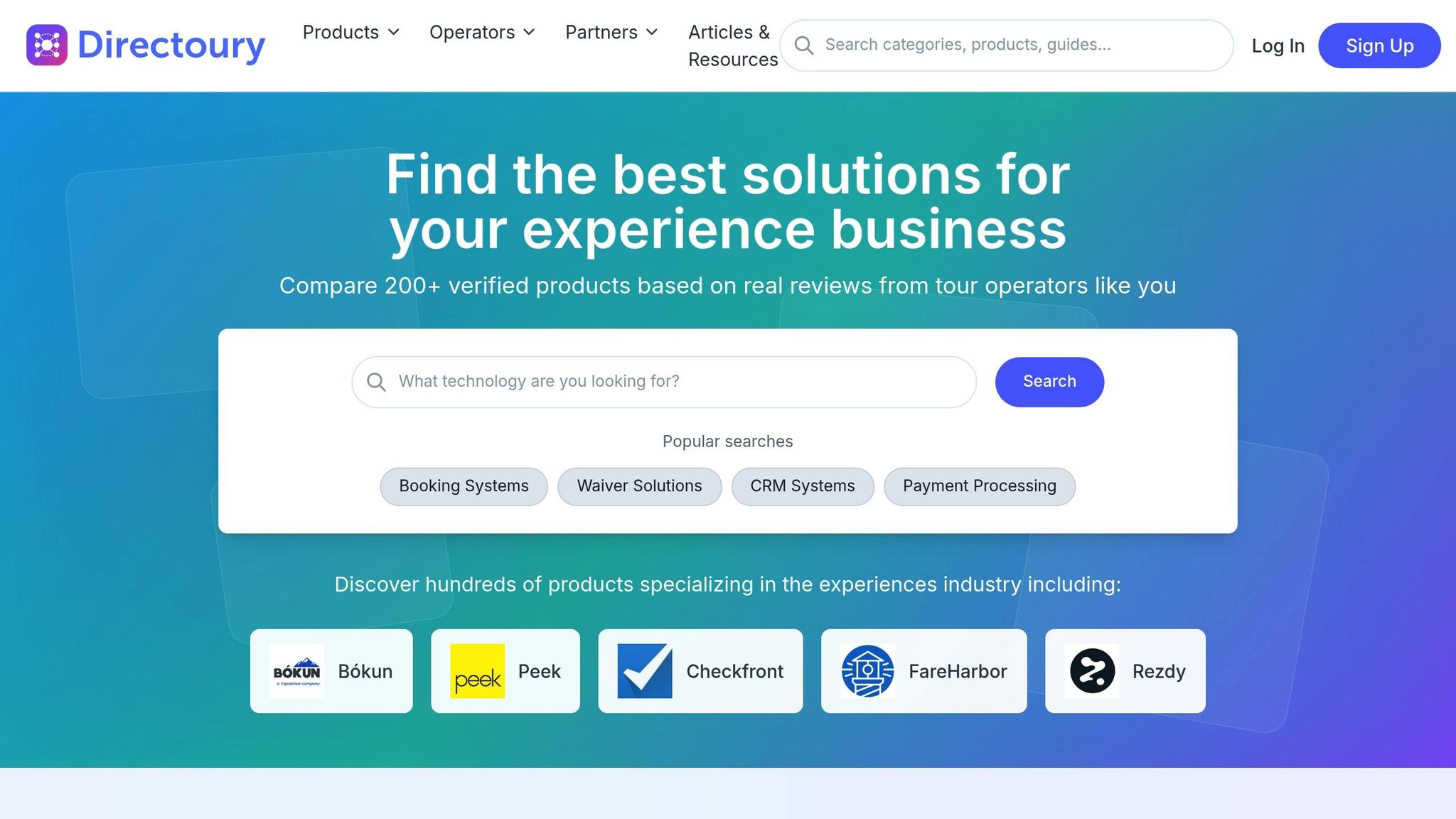
Choosing the right CRM can feel like navigating a maze. Directoury simplifies this process by offering a marketplace specifically designed for tour operators and experience providers aiming to streamline their technology stack.
How Directoury Helps You Choose a CRM
Once you understand how CRMs can transform your operations, Directoury steps in to help you find the perfect fit. Using AI-powered recommendations, the platform matches you with CRM systems tailored to your business model, size, and goals.
You’ll gain access to 200+ verified vendors and reviews from travel professionals who’ve actually used these systems. Why does this matter? As Ben Finch from Palisis puts it:
"Fake reviews seem like a great investment... In the short term, but it erodes your reputation in the long run".
By relying on verified feedback, you can avoid costly mistakes and choose a CRM that genuinely delivers results.
Directoury’s matching service doesn’t just focus on generic features - it dives into the specifics that matter most to tour operators. Whether you need advanced itinerary tools for luxury tours or abandoned-booking recovery for high-volume operations, the platform ensures you find a solution that aligns with your needs. It even breaks down cost models so you can make informed decisions. Beyond CRMs, Directoury also supports other aspects of your technology stack.
Other Tools Available Through Directoury
Directoury isn’t just about CRMs - it’s a one-stop shop for all your tech needs. From booking platforms and payment processing to marketing automation, HR tools, payroll systems, and reputation management, the platform covers it all.
To help you make sense of it, Directoury offers in-depth guides and resources explaining how each tool fits into your overall technology stack. Whether you’re looking to integrate your CRM with back-office software to eliminate double data entry or planning a complete tech overhaul, Directoury’s free expert guidance helps you create a seamless, efficient system that works for your business.
Conclusion: Is a CRM Right for Your Business?
A CRM can be a game-changer for businesses looking to streamline operations, reduce manual work, and drive growth. If you’re losing inquiries during busy periods or spending endless hours on data entry instead of focusing on growth, it’s time to consider a CRM. Disorganized customer data doesn’t just create headaches - it costs you money. In fact, companies that use a dedicated CRM see improvements in customer relationships by up to 74% and increased sales quotas by 65%.
The numbers speak for themselves: a well-implemented CRM delivers between $2.50 and $5.60 for every dollar invested. And with 68% of customers leaving due to feeling ignored, plus the fact that responding to a lead within an hour makes you seven times more likely to engage in a meaningful conversation, the risks of not having a CRM become impossible to ignore.
To determine if a CRM is right for you, take a closer look at your current operations. Map out your workflow from the first inquiry to post-sale follow-up. Where are the bottlenecks? Are bookings slipping through the cracks? Are repetitive tasks eating up valuable time? If the cost of these inefficiencies outweighs the price of a CRM subscription, the decision becomes clear. Addressing these challenges with a CRM can help optimize your processes and reclaim lost revenue.
Directoury’s AI-powered platform simplifies the process of finding the right CRM for your business. With access to 200+ verified vendors and reviews from travel professionals, you can identify a solution tailored to your needs. Whether you’re a small operation needing visual pipelines starting at $14/month or a luxury tour provider requiring advanced itinerary management, Directoury breaks down pricing, including hidden fees, so you can make an informed choice.
The real question isn’t whether you need a CRM - it’s how much longer you can afford to operate without one. Take advantage of Directoury’s free resources and start building a tech stack designed to help your business thrive.
FAQs
Why should a small tour operator consider using a CRM?
A CRM can reshape how small tour operators handle their business by consolidating all customer details - like contact info, booking history, and preferences - into one central hub. This eliminates the chaos of scattered spreadsheets and minimizes costly mistakes such as duplicate entries or billing errors. It also simplifies daily operations, turning inquiries and bookings into smooth, repeatable workflows.
With a CRM, segmenting customers becomes effortless. You can group them by travel preferences, favorite destinations, or booking patterns, making it easier to create targeted marketing campaigns that boost conversions and encourage repeat bookings. Plus, a CRM gives you a clear snapshot of your sales pipeline, upcoming trips, and revenue projections. This insight helps you make smarter decisions about pricing, staffing, and marketing - while freeing up time to focus on expanding your business.
For small tour operators, the top advantages of a CRM include: centralized and accurate customer data, automated processes that improve efficiency, and actionable insights to increase sales and streamline operations.
What costs should I consider when choosing a CRM for my tour business?
When planning your budget for a CRM, it’s essential to think beyond just the subscription price. Most CRM platforms follow a monthly or annual subscription model, with costs varying based on the number of users, features, and support levels. While some providers offer free plans, these typically come with limited capabilities. To access advanced tools - like automated marketing or custom reporting - you’ll likely need to move to a paid plan.
Don’t forget to factor in implementation costs, which can include setting up the system, migrating customer data, and tailoring workflows to suit your business needs. These steps may require time, consulting services, or internal resources. However, the efficiency gained from automating tasks like follow-ups, booking management, and invoicing often offsets these upfront investments.
Ongoing costs are another consideration. For example, you might need to pay for integrations with booking systems or email platforms, additional storage, premium support, or scaling as your business grows. Taking all these elements into account will help you decide whether the CRM fits your business goals and supports your long-term growth.
How can a CRM help improve customer satisfaction and keep travelers coming back?
A CRM (Customer Relationship Management) system is a game-changer for tour operators aiming to deliver a more personalized and smooth experience for their guests. By consolidating customer preferences, past bookings, and feedback in one central hub, it empowers you to offer tailored recommendations, send timely updates, and address potential issues before they escalate. The result? Travelers feel genuinely valued and understood.
With all customer data and communication streamlined into a single platform, your team can respond faster, avoid mistakes like double-bookings, and maintain consistent service across sales, marketing, and support channels. This level of reliability not only builds trust but also encourages repeat bookings, directly contributing to higher customer satisfaction and retention.
On top of that, automating routine tasks - such as follow-up emails, surveys, or loyalty offers - frees up your staff to focus on creating meaningful connections with guests. This approach not only elevates the quality of service but also strengthens guest loyalty, ultimately driving revenue growth over time.